
The wrong question is often “Which model is strongest?” The useful question is “How much intelligence does this stage of the workflow require?”
OpenAI gives the three models distinct roles. GPT‑6 Astra is the flagship for the most demanding reasoning, coding, and professional work. GPT‑6.1 Sol aims for near-Astra performance on complex work at a lower cost. GPT‑6 Luna is optimized for focused, high-volume, cost-sensitive tasks.
For AI-drama production, these models do not have to be mutually exclusive. A practical default is to use Sol for most work, escalate a small number of difficult decisions to Astra, and route repetitive, well-specified tasks to Luna.
Core specifications
The table uses standard text-token pricing published in OpenAI’s documentation at the time of writing. Prices are per one million tokens. Long prompts, cache writes, tool calls, and processing tiers may be billed differently.
All three support text and image input, text output, and tool use through the Responses API. They are not direct video-output models; in an AI-drama workflow, their role is reasoning, planning, review, and tool orchestration.
Choose GPT‑6 Astra for high-impact ambiguity
Astra becomes valuable when one incorrect decision could create substantial downstream rework and the problem itself is ambiguous.
Examples include adapting a structurally complex novel into a season arc, resolving multiple timelines or unreliable narration, balancing commercial and creative constraints, repairing a contradictory story bible, or designing a complicated agent workflow with several tools and approval boundaries.
Astra has the highest per-token price of the three. There is little reason to use it for every shot title, file name, or formatting operation. Reserve it for decisions where a stronger global judgment changes the project.
Choose GPT‑6.1 Sol as the production default
Sol is the most practical default for many creators. OpenAI positions it as a lower-cost way to obtain near-Astra performance on complex coding, computer-use, and professional tasks.
In an AI-drama project, Sol can analyze chapters, extract assets, create Episodes and Shots, convert internal thought into visible action, design generation prompts, audit continuity, diagnose failed shots, and use tools to maintain the project and update a canvas.
If you do not want to select a model for every task, run the workflow with Sol first. Escalate only the hardest decisions to Astra, and move highly repetitive operations to Luna after evaluation.
Choose GPT‑6 Luna for volume and clear rules
Luna fits tasks with stable output formats and limited ambiguity:
- converting Shot data into JSON or tables;
- normalizing character and location names;
- creating short titles and tags for many shots;
- checking required fields;
- summarizing generation-task status;
- drafting multilingual subtitles;
- producing delivery checklists from an approved template.
Luna also supports higher reasoning efforts, but model selection is not determined by a parameter name alone. For complex adaptation or ambiguous creative judgment, compare its revision burden with Sol on representative material before routing the workload at scale.
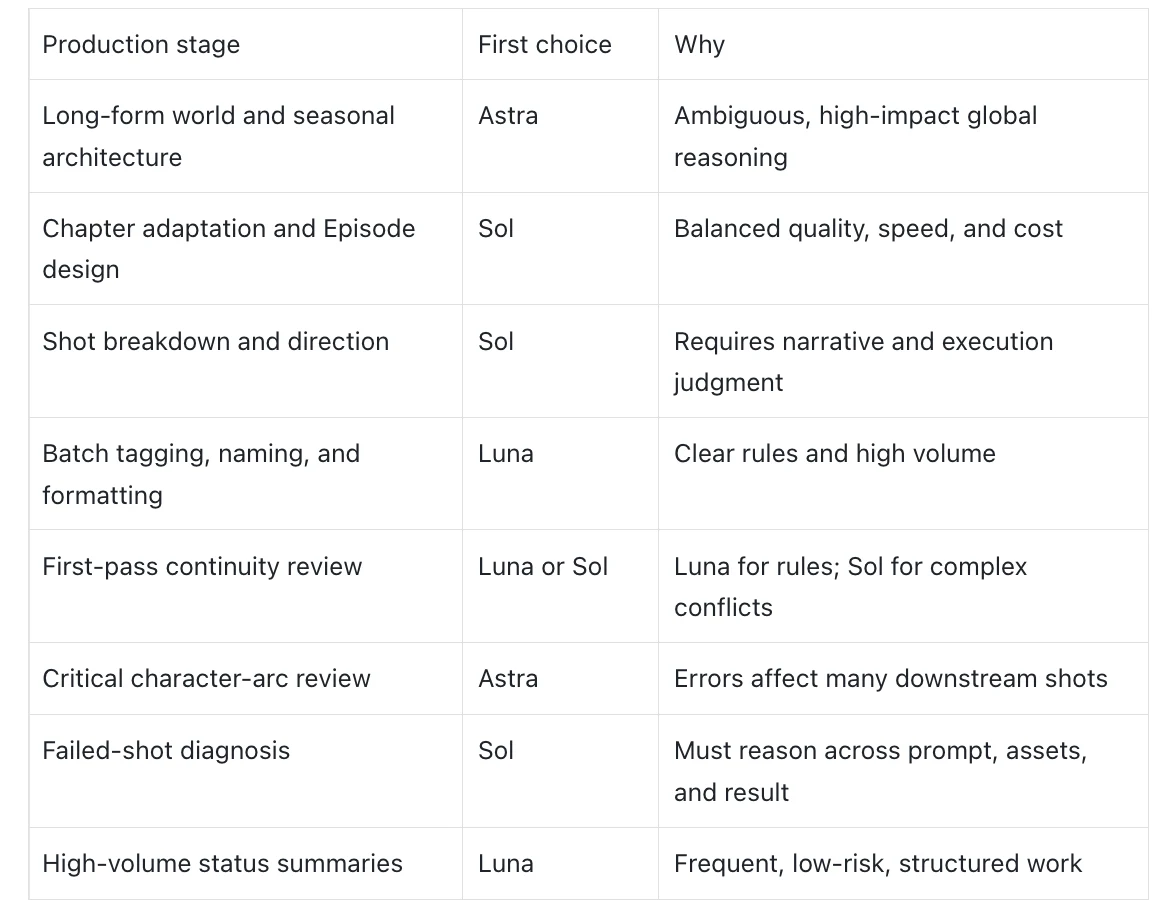
Model selection across an AI-drama workflow
Production stage
First choice
Why
Long-form world and season architecture
Astra
Ambiguous, high-impact global reasoning
Chapter adaptation and Episode design
Sol
Balanced quality, speed, and cost
Shot breakdown and direction
Sol
Requires narrative and execution judgment
Batch tagging, naming, and formatting
Luna
Clear rules and high volume
First-pass continuity review
Luna or Sol
Luna for rules; Sol for complex conflicts
Critical character-arc review
Astra
Errors affect many downstream shots
Failed-shot diagnosis
Sol
Must reason across prompt, assets, and result
High-volume status summaries
Luna
Frequent, low-risk, structured work
How to choose a reasoning effort
- low: title rewrites, formatting, and simple asset extraction;
- medium: a sensible starting point for most Episode, Shot, and continuity work;
- high: complex adaptation, failure diagnosis, and multi-constraint shot planning;
- xhigh or max: a small number of unusually difficult, high-impact tasks where additional latency and cost can be justified.
GPT‑6.1 Sol and GPT‑6 Astra do not support none; GPT‑6 Luna does. OpenAI recommends the Responses API for tool use. Do not set every request to the highest effort by default—evaluate representative tasks first.
A more economical mixed-model strategy
For an AI-drama episode with 20 Shots, routing might look like this:
- Astra reviews the adaptation strategy, character arc, and three critical narrative decisions.
- Sol performs chapter analysis, Episode and Shot design, prompting, and failure diagnosis.
- Luna handles names, tags, structured fields, task summaries, and delivery checklists.
The goal is not simply to minimize token price. It is to ensure that expensive reasoning is used only where it changes the outcome.
Working with ElserStudio
ElserStudio holds the World, canonical assets, Episodes, Shots, generation tasks, and canvas state. With the official Skill and local MCP connected, agents can work from the same project facts.
That becomes especially important in a mixed-model workflow. Whether a step uses Astra, Sol, or Luna, the canonical character and Shot state should not exist only inside one conversation. Keep project truth in ElserStudio and let the selected model operate within the context and authorization provided for that task.
To evaluate the combination, you can download ElserStudio, create one World and two or three Shots from a short passage, and give the same storyboard or continuity task to all three models. Track revision effort, response time, and actual API cost before choosing a default route.
Practical recommendation
- If you want one default model, begin with GPT‑6.1 Sol.
- If the task is unusually complex and errors are expensive, escalate the critical stage to GPT‑6 Astra.
- If the task is high-volume, well specified, and budget sensitive, test GPT‑6 Luna first.
- If you are building a repeatable pipeline, use Sol by default, Astra for escalation, and Luna for batch work.
The right answer will not come from a leaderboard. Test the three models on the same source passage, the same canonical assets, and the same acceptance criteria. That is the comparison that reflects your production reality.